Tuesday, August 30, 2011
The Yellow Lamborghini
When I was nine years old our family lived in Caracas, Venezuela. There was a small shop on a corner a few blocks down the road from our house. It was more of a hut than anything. A trap door flipped up and there was a mean lady in there. She sold candy, magazines and cigarettes. When I rode my bike to my friend’s house we would ride over to the mean lady’s hut to buy gum. There were only two flavors of gum in Venezuela, bubble gum or banana. They came in a rope. You tore off some to chew and saved the rest for later. I didn’t chew gum but my friend did so we went to the hut every few days.
Poverty dictated rules of how to coexist in Caracas. You were rarely hassled but you had to watch your things. Leave something unattended and it was up for grabs. We knew this so we locked our bikes, even if they were parked in our own driveway.
One day at the hut we set our bikes down for a moment. A yellow Lamborghini veered off the busy street and rolled onto the sidewalk in front of the hut. Pneumatic valves hissed and the top opened like a clamshell. A hale young man in disco clothes jumped out and bought a pack of cigarettes from the mean lady. He climbed back in, the pneumatic valves hissed as the top shut and he tore up more of the sidewalk as the yellow roar disappeared into the flow of traffic.
We looked back at our bikes. My friend’s was missing.
“There!” he shouted, pointing down the street at a ragamuffin riding away. “Go after him!”
I scrambled onto my bike and pedaled quickly. The little thief knew I was in pursuit so he cut across traffic to the other side of the freeway. I was not allowed to ride in the street but still I followed him into the fast lanes of oncoming traffic. Tires screeched and horns honked. I felt a strange burst of energy as I pedaled for my life across the freeway. When we lived in Mexico a car struck me and I almost died. I had a broken leg and a fractured skull from that. Now I was doing the same stupid thing. Hit a car and I was dead. Lose my balance and I was dead. Cars swerved, their tires squealing.
I made it to the other side. The little boy on my friend’s bike was a short way ahead, racing up a hill.
I knew the hill.
It was part of the route I took every day. As I would tire I would climb this hill, just making it to the top. The rest of the ride was reward, mostly downhill back to home. I could see the boy begin to struggle on the incline and I knew I could catch him. At school I was a terrible athlete, the last picked for any team. I had a gentle disposition and I was uncoordinated. But on a bike, by myself, I had skills.
I tapped into my reserve and pedaled up the hill with everything I had. It was no contest. The little boy could barely move another few feet before he was teetering. I pumped hard on my pedals a few more times. Then I was there. I grabbed the handlebar of my friend’s bike. I had caught the thief.
The boy looked at me. I looked at him.
Nothing happened.
The boy didn’t get off the bike and run away. He sat. I held the handlebar firmly but he didn’t wrestle away. Stalemate. I didn’t want to fight him. I had never fought anyone. I wanted him to be afraid of police or something.
Older boys emerged from the weeds next to the hill. The little boy hopped off my friend’s bike and an older one climbed on in his place. With a gentle tug he pulled the handlebar free of my grip. No one threatened me but I was confused. I felt I had won this particular contest, like in school where you received a blue ribbon and teachers wrote your name at the top of a list. I wanted to walk away with both bikes.
But the oldest boy rode away while the others crowded around me. I felt my chest cave as I watched my friend’s bike disappear around a corner.
“Ay,” one of the boys lamented, gesturing to the top of the hill.
I turned my bike around to leave. I wanted to go home.
“No,” another boy said and pointed up the hill.
They didn’t block me from leaving but they pleaded with me. I spoke enough Spanish to hear what they were saying but I feigned ignorance. They told me they felt bad about the oldest boy riding away. They wanted fetch my friend’s bike. They wanted to help me.
But I would need to loan them my bike.
I knew they were lying. I also knew the boys could have overpowered me, yet they didn’t. They only pled, telling me how much they wanted to help, to fix this injustice. If only they could use my bike to chase the thief, they would catch him and bring both bikes back to me.
I pretended not to understand. “No hablo español,” I told them many times.
The fattest of the boys gestured up the hill. He was shirtless and had dirty cutoff jeans. His round potbelly jiggled with his every move. He mimicked pedaling. He brought his arms together as if he were snatching someone. Then he mimicked pedaling back to me.
Please, please believe we want to help.
I stepped off my bike and the fat boy got on. He tapped his heart and pointed up the hill. He gestured for me to wait. The boys disappeared with him.
I sat there for a while, in the weeds on the side of the road. I knew they would never come back. I watched the cars whiz by on the freeway at the bottom of the hill. I came up with the story I would tell my parents at home: I chased the little boy on sidewalks and never sped across the freeway. The boy led me into a trap where I fought valiantly with a brutal gang. The oldest boy—no, a man—had a knife and yet I still fought for the bikes. When the knife was at my throat I released my grip on the handlebars. After going through the story a few more times I rubbed dirt on my cheeks, squeezed my eyes shut so it looked like I had been crying and walked home.
Many years later, when retelling the true version of events to MJ, I asked her opinion why I did what I did, because I still didn’t know. The boys never threatened me. We were about the same age and I could have ridden away. They didn’t have bikes and I did. My friend’s bike would have been stolen but I would have kept my own. I loved that bike.
“You didn’t want them to know you thought that little of them,” MJ said.
It was true. The boys lied to me about their intentions. They weren’t asking for my bike because they were poor and I was rich. For that, they might have had a case. Instead, they tried to deceive me and lied about what they wanted to do with my bike. I knew they were lying, and they also knew that I knew this. They sensed in me the weakness that I could not tell this to them. I could not say to their face I believed in my heart it was their intention to steal. I was always taught compassion and understanding for the underprivileged and they smelled this. The lady in the hut was poor and I never wondered why she was mean. I thought she had a terrible life and she had a right to be mean. I bought gum from her even though I didn’t want any.
When my mother saw me stagger into our house that day I burst into tears and told her the whole story—the fake one—about the gang with the knife. She called my friend’s mother and they talked for a long time while I deflated into the couch in our music room. My mother hung up the phone and told me she was impressed with how I had handled the whole situation.
“Like a mature adult,” she said many times that day. A knife’s twist in my heart, those words.
My father took me to a store the next weekend to buy a new bike. My old one was of simple design with yellow handlebars. The new one was sleeker, black, and it had wavy lines decorating the sides. Emblazoned across the front of the handlebars, in fiery capital letters: BANDIT.


Tuesday, August 23, 2011
Power Off
I have been home for a week now, and I need to write down what the past few days have been like. I don't have a lot of energy, but in a few words here it is: I must have been on some kind of adrenaline high through two weeks of Cabrillo and now I'm on the other side of it, crashing every few hours.
I haven't felt this way in over a year, but at dinner a few nights ago I felt the sensation of my whole body shutting down.
Power off. Sofa.
Nothing like an emergency situation, but it was a familiar way to go for a few months after the surgeries when I was convalescing. Back then I would try to do a few things around the house, then when I felt the OFF I went to the couch and stayed horizontal until it passed. Body was still healing and I didn't fight it. It's been a long time since I felt this need to SHUT DOWN.
When we arrived at Cabrillo a few weeks ago, I wondered if I would be up against this phenomenon. A few days in, I did come up against the "marathon wall" and I pushed through it instead of backing off as usual. Much to my surprise I didn't pay for it the next day. Instead, I felt more and more "normal" in energy level than perhaps I ever have since the surgeries. (There were a lot of bear claws and espressos in the mix too.) It was a rush, and I rode the wave all the way through our last notes at the festival.
Since we came home, I have felt my body "relax into" moments. If I had to guess, my body latched onto this idea of letting go for a while and it just shuts down. It's hard to describe exactly, because it's not the same as "I'm so dog tired ... give me the remote and a glass of wine." No, this is—quite seriously—horizontal shut-down mode. No reading, no TV, no sleep (surprisingly) but just ... well ... SHUT DOWN. That's the best I can describe it.
I'll end with some good news: On Friday I have a follow-up with the retinal specialist about the red dot. Since Cabrillo the red dot is gone, and I don't think this is a coincidence. There is a faint ghostly image still in my right eye, but for the most part it is gone. There is nothing like making great music with friends to take away anxiety in your life.
I haven't felt this way in over a year, but at dinner a few nights ago I felt the sensation of my whole body shutting down.
Power off. Sofa.
Nothing like an emergency situation, but it was a familiar way to go for a few months after the surgeries when I was convalescing. Back then I would try to do a few things around the house, then when I felt the OFF I went to the couch and stayed horizontal until it passed. Body was still healing and I didn't fight it. It's been a long time since I felt this need to SHUT DOWN.
When we arrived at Cabrillo a few weeks ago, I wondered if I would be up against this phenomenon. A few days in, I did come up against the "marathon wall" and I pushed through it instead of backing off as usual. Much to my surprise I didn't pay for it the next day. Instead, I felt more and more "normal" in energy level than perhaps I ever have since the surgeries. (There were a lot of bear claws and espressos in the mix too.) It was a rush, and I rode the wave all the way through our last notes at the festival.
Since we came home, I have felt my body "relax into" moments. If I had to guess, my body latched onto this idea of letting go for a while and it just shuts down. It's hard to describe exactly, because it's not the same as "I'm so dog tired ... give me the remote and a glass of wine." No, this is—quite seriously—horizontal shut-down mode. No reading, no TV, no sleep (surprisingly) but just ... well ... SHUT DOWN. That's the best I can describe it.
I'll end with some good news: On Friday I have a follow-up with the retinal specialist about the red dot. Since Cabrillo the red dot is gone, and I don't think this is a coincidence. There is a faint ghostly image still in my right eye, but for the most part it is gone. There is nothing like making great music with friends to take away anxiety in your life.
Saturday, August 20, 2011
Thoughts after Cabrillo
I was humbled by the way I was welcomed back to Cabrillo this year. There are no other words for this. People treated me like a war hero making a triumphant return. I have been “normal” in appearance for a while now, but most of my Cabrillo friends had not seen me since before the brain surgeries. I’m sure they wondered all the obvious things. Was I going to look or act weird? Talk funny? Be dead weight? I’m sure these things went through everyone’s mind. It’s only natural. But as the festival went on I knew I belonged there, craniopharyngioma or not. I belong at Cabrillo as long as I can nail it the way everyone else there does. We all earn our spots year after year.
As I write this I am flying on an airplane so my mind turns to another person—a pilot—who gets the “hero” treatment.
Captain Sully.
Everyone loves this person. He landed a plane full of passengers on a body of water and everyone survived. The Miracle on the Hudson, they call it, and he was the kind of reluctant storybook hero we all needed when times were darkest. In his interviews following the miracle he looked like a DNA mashup of Chuck Yeager and Fozzy Bear. While he wowed us with statistics about gliding airspeeds and density altitudes we wanted to hug this man and feel the scratch of his mustache against our cheeks to let us know everything was all right. The plane crashing into the Hudson was a metaphor for the recession and Captain Sully was the numbers guru with the heart of gold.
I wonder how I might stack up to Sully. The reason I consider this is I still work. See, he doesn’t fly anymore, yet everywhere he shows up—on Thanksgiving floats, talk shows—people weep when he walks in the room. I have to work to get the same treatment. Every day I battle small issues and overcome them so I can stay at a high level.
Imagine if Sully had to do that.
Imagine a David Letterman stunt. Sully walks in the room. Everyone’s heart melts with fuzzy feelings. Letterman pulls the curtain and tells Sully he wants to see it again. He has an airplane ready for taxi at La Guardia. With a SullyCam we watch him pre-flight, file a flight plan, listen to the ATIS, call for clearance, contact ground control, taxi to the departure runway, radio the control tower, pull the throttle out, roll down the runway, hand off throttle at V1, pull back at Vr, adjust for Vx, retract landing gear, adjust for Vy, switch radio frequencies between tower and departure, level off, trim, kill the engines, adjust for best glide speed, cross fingers and crash into the Hudson.
This is how I feel every day. If I don’t demonstrate my ability to land the plane—every day—I wouldn't be a hero to anyone. I would be just a lucky patient who survived (with very good odds to begin with, don’t forget). I’ll get flak for writing this, but it is such a big part of me it would be disingenuous to omit. The reward for getting past this hurdle in my life is not the celebration of what I did (looking back) but the return to what I was before (looking forward).
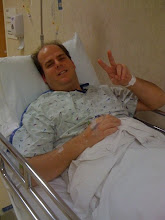
This has been the driving force within me since the moment I woke up from my first brain surgery. I had a painful spinal tap, gauze stuffed up my nose, a hole in my skull, oxygen tubes in my mouth, machines beeping every time I moved (see picture below) … and all I thought was how my first goal was to get to where I was five minutes before this freight train hit me. I’ve done that now. It took me two years. Now the next step is mine.

Tuesday, August 9, 2011
Halfway through Cabrillo
One week down, one week to go at Cabrillo. The first week of concerts was—in the opinion of many—one of the best in memory. The most exciting part about Cabrillo is the presence of so much artistic excellence everywhere I look. Santa Cruz is small, and the streets have a way of tumbling people into one another. It’s hard to hide and everyone is literally rubbing shoulders with everyone else. As I lean across the breakfast table to grab another bear claw I brush past a Pulitzer Prize-winning composer just idling there, deep in thought as he sips on a cup of coffee. I never mention names in my blog, but the talent out here is on some other astral plane, let me tell you. The orchestra musicians, the soloists, the music direction, the composers and the audiences are all fantastic and we feed off each other’s zeal, passion and energy. Four hundred people attended our first rehearsal. The concerts, featuring some of the most difficult new music imaginable, are sold out. Cabrillo is a special place in my heart, a unique part of music history that rewrites music history every year.
On to my health. Two minor brain shocks last week. I am stressing they were MINOR (only 3 on a scale of 1-10) but they are notable because this is the first recurrence of this phenomenon since May. The image I get (I wrote about this before) is of an alien ray gun pointed at the left side of my head. For a second it feels like my brain melts away and then pops with a painful jolt. A half-note downward glissando with a percussion hit at the end. Before I know what has hit me it is over. I never know when the next one will come. It could be minutes or months. When the two brain shocks hit last week I was deep into playing technical passagework, losing myself in the music.
I try to be careful about this but it’s harder when the musicianship around me is full of fire. In the back of my sinus cavity there is only tissue now where there used to be skull. The hole is about the size of a dime. I have a slice mark on my belly to remind me where they extracted this tissue to plug this hole in my head. Common sense tells me bone is solid and tissue has “give.” With the high air pressure of playing the oboe I wonder if the tissue plug bounces in and out when I play and rest. It’s a little gruesome to think about things like this, but I’m starting to wonder if slight on-off pressure changes in the area of the brain behind my sinuses could be responsible for this intermittent brain shock phenomenon.
When I returned to playing a few months after recovery, I took things easily. I played on the easiest reeds and my orchestra’s management accommodated me with anything I needed for gradually working back to a full schedule, never pressuring me to push it any farther than I wanted to. I was determined every week to be one step farther along while maintaining constant vigilance about watching for leaking spinal fluid again.
Because I took things slowly and carefully, I didn’t suffer setbacks during rehab. I have now tested the tissue plug with the heaviest levels of playing I know and it’s staying put. But I wonder if the plug still moves or bounces a millimeter or two with the pressure changes. Once again, I ask myself how many professional oboists have had two craniopharyngioma resection neurosurgeries and then made it back to their previous level of playing? If I make it through the rest of Cabrillo, I could be the first.
Wednesday, August 3, 2011
Back at Cabrillo
Now that my blog is homing in on its two-year anniversary, I know its most useful trait lies in the archives. I can judge where I am and how far I have come (or slipped back) based on the content and tone of my earlier entries. I do plead guilty to being a good writer and I turn that to my advantage by—in so many words—being myself as much as possible when I write. A few times I stray, but for the most part my goal is to write exactly what I feel compelled to write at any moment, nothing more and nothing less. What we feel compelled to do tells us most of what we need to know about ourselves.
I am writing this from Santa Cruz where I am playing in the Cabrillo Music Festival for the next two weeks. It’s good to be back here. I’ve had a few days to take in everything again. My last memories are blurry. Two years ago I was not home from Santa Cruz more than a few weeks before my life went into a tailspin. In the years before that I could smell salty air and roasting coffee for months, but two years ago everything cut jarringly to the sterile textures of hospitals, syringes and ICUs before I knew what had hit me. I had no time to reflect so I set things in a corner of my mind, not gone, not forgotten, just idling there abstractly.
The coffee. It’s the coffee, and now I understand. We drove the twisty CA-17 down from San Francisco Sunday morning and, like Odysseus beckoned by the Sirens, we wanted coffee. The barista was as pierced as she was opinionated. She must have pulled four or five shots of espresso before she thought one was good enough. It was worth the wait. $2.65.
The salt. It’s the salt in the air. Cars are crusted with it. Plants are hearty or they would never survive this. Even up in the mountains you don’t feel very far from the sea. The salt is everywhere. This is why the coffee needs to be so strong.
The grunge. This is unmistakable in Santa Cruz. There are isolated elements of it all over the place but it has a way of peacefully coexisting. Don’t mess with it and it won’t mess with you. I looked down one street and I knew we were in Santa Cruz again. A young woman on a bicycle riding away from us sported long dreadlocks, the kind you get from never washing your hair. I watched her curiously as she turned the corner and—wait!—that was a dude. [Slaps forehead.] Another man riding the other way balanced himself between two dirty plastic bags. He sat atop his creaky old bike and hunched, the two bags pulling him to one side and then the other. A gray wool cap with a pompom covered his head.
The sanddabs. I dream of these little flatfish in the dead of winter. When I run into a fellow Cabrillo musician out of season, the conversation takes a detour to sanddabs every time. “Ooooh, we gonna have us some sanddabs!” he always says. Sanddabs are to Santa Cruz what razor clams are to Oregon and Washington.
The music. And this is why we are here, no question. No coffee, salt, grunge or plate of sanddabs could lure us here year after year without the music. In two weeks of tightly packed rehearsals and concerts we play more new orchestral music than we would in five years with our regular orchestras. There is a white-hot energy that permeates the playing here. Every piece is a world premiere, a U.S. premiere, or a West Coast premiere. Everything is new, brand new, and we are right at the source. You can’t get closer to new music than this without getting inside the heads of the composers themselves.
Bad image. As for me, I’m doing all right after a few days of playing here. I’ve been conservative about how far to push it, and if I feel anything strange I just stop playing until it goes away. For the record, I’ve backed off from blowing about three times so far. Three times in three days is nothing serious for me. I’m going to bed and waking up in one piece.
The red dot in my right eye is SMALLER now, half the size it was when we left Grand Rapids. Since the partial retina detachment is caused by stress and anxiety, I wonder if I was more anxious about my return here than I will admit to myself? I don’t know. I don’t think so, but I wonder. Cabrillo was the last place I felt free as a non-patient before my apple cart upended suddenly. I wonder if I was afraid to find out what it was going to be like to be back, to be caught off guard with the knowledge that I couldn’t do it anymore. Maybe I was anxious about that. Again, I don’t know, but so far I feel like I’m keeping up with everyone and not—my worst fear as a professional—holding anyone back. I didn’t play last summer because of this very reason: too many variables with my fragile condition. This summer I still wrestle with medical issues but I know what they are. I know my limits and I know how to pace myself, now proudly back at the highest level I know.
Monday, July 25, 2011
Junkies Say the Darndest Things
When I was in the 10th grade, classes were canceled one day so we could talk about drugs. There were maybe fifteen of us in one of the rooms sitting in a semicircle, facing a teacher and an ex-junkie who likely was court-ordered to do this. The ex-junkie had long blonde hair in a ponytail and he moved with the boneless demeanor of a novice surfer. The teacher was in every way his opposite: balding, angular and reserved. They passed out sheets with columns titled, “Ages 11-13, Ages 14-16, Ages 17-21.” We were supposed to write our feelings in the blank spots.
The junkie spoke, “See, we’re gonna talk about this from like what the different ages would be affected like.”
The teacher stole a sideways glance at the junkie and added, “We will go around the room and talk freely about our experiences. You are safe to speak here.”
The kid on the far end raised his hand. “We can say anything?”
“Yes.”
“11 to 13,” the junkie started. “Like, how do you feel about drug use at that age? Good? Bad? How would it like affect an 11-year-old, you know?”
The first kid shook his head, “That’s real bad for someone so young.”
“Bad,” the next kid said.
“Bad.”
“Bad.”
When it was my turn I said the same thing: “Bad.”
So did everyone after me.
Until the kid on the end: “This friend of my brother’s? We went to his house and he lit a joint and blew pot smoke in a dog’s face and the dog walked wobbly and could only stand if it leaned against a wall.” A crooked grin crisscrossed the lower half of his face and he blurted this with the alacrity of a stand-up comic. His eyes widened while his eyebrows arched crazily. “The dog was like, ‘Oooor, roooor, oooooorr,’” he howled while swaying back and forth.
“Uh,” the teacher said. “Thank, uh, next age group.”
“14-16. What about drug use at that age?” the junkie asked us. “That age group is trying for Varsity.” He tapped two fingers to his head. “Think what effect using drugs would have on those chances moving up from J.V.”
The first kid shook his head again. “It’s really bad at that age.”
“Bad,” the next kid said, as did the next few.
“It’s bad,” I offered. “But also sad.”
“Bad and sad,” the teacher said. “Interesting.”
“Bad and sad,” the next kid said.
“Bad and sad.”
“Bad and sad.”
The kid on the end: “This friend of my brother’s? We went to his house this other time? He has a parakeet and he covered the cage with a sheet and blew pot smoke in there and the bird hung upside-down from its perch and tweeted crazy stuff.”
The teacher expectorated a staccato snort and then banged his chest with his fist. He tried to recreate another cough to sound like the previous bark of laughter but it wasn’t even close. The junkie adjusted his tie and stared at his loafers.
Later in the seminar they handed us another sheet with multiple-choice questions. One asked:
What is the best antidote for taking drugs?
A) Other drugs
B) Alcohol
C) Coffee
D) Lots of rest
“Coffee,” said one kid when prodded for an answer.
“No way,” blurted the kid on the end. “You use coffee for a downer, not for coke. You don’t freebase and then gargle Folgers Crystals unless you want to blow up like Richard Pryor, you doofbag.” He flicked his finger on the back of the other kid’s head.
The junkie smiled wryly, clapped his hands once and pointed at the kid on the end.
The teacher jumped in, “Look, uh”—he set the paper down—“let’s um, let’s talk for a minute.” He turned to the junkie and said, “Just tell them the truth. All of it. About drugs.” The teacher turned one palm up and made a sweeping gesture to us.
“The truth?” The junkie set his paper down as well. “The truth is drugs are great. Yeah.”
I have never seen a more panicked look on a teacher’s face.
The junkie said, “If they weren’t great they wouldn’t be a problem, right? But they’re great … until they’re not. And when they’re not they ruin your life. But—honestly—if I could do drugs again without problems, I would do it. But now I know problems come later and I won’t ruin my life twice.”
The teacher’s face eased only slightly.
“That’s the truth,” the junkie said. “You asked me for it.”
When we lived in Caracas, Venezuela I was in the 3rd through 6th grades. Our house had iron bars on the windows. A steel door separated our backyard from the world outside. The one time we didn’t lock our car someone tried to steal it. We were allowed to ride bikes to friends’ houses but we knew to be careful.
One afternoon my mother took us to the park. A scrawny Venezuelan boy about my age played around the bushes so I joined him. His clothes were dirty and torn but I didn’t mind. He was nice. In his cupped hands was a small bird. This interested me because we had pet birds too.
“¿Como se llama tu pájaro?” I asked him.
“No se,” he replied.
“¿Es un canario?”
“No.”
The boy opened his hands and showed me. It was a sparrow.
He wandered away and I watched him curiously. With his back turned, I saw one arm work in a whittling motion into the other. Downy feathers flew into the air and fell to the ground. My mother yanked me away when she pieced together what was happening. The boy was hungry. She gave him some money and we didn’t go to that park again.
Another time in Venezuela, a gang of children stopped my bike on the sidewalk. The boys parted and the oldest of them approached. He laughed at the streamers dangling from my bike’s handlebars.
“¿Sabes que es ‘marijuana’?” he asked me.
“No.”
He pretended to inhale slowly while holding his index finger and thumb to his lips. “Ma-ri-jua-naaaaaaa…” he said dreamily.
“¿Es un cigarillo?” I asked.
All the boys laughed and the oldest said, “Es un TIPO de cigarillo.” The boys laughed harder. “Es un tipo muy … especial.”
I pushed hard on my pedal and the boy stopped me easily. He flicked the streamer on my handlebar and sneered, “Adios, niña. Adios, muchacha.”
He stepped aside and I sped home.
Another day I saw a man stumble into the street with his arms flailing. In no time he was down on the asphalt in the middle of the road. One of his arms moved in a circular motion that reminded me of “yummy in my tummy,” but the way he did it was odd and mechanical. There were no cars on the street so I pedaled to him and stepped off my bike. The man’s face was frozen tight. An adult who had seen this now ran in the road with me. The man lay on his side with his neck curled tightly to one shoulder and the top of his head pressing into the pavement. The circular motion of his arms stopped, leaving his whole body awkwardly contorted.
I touched him. He was stiff.
The adult next to me touched him also. He shook his head.
“¿Muerto?” I asked.
“No,” the adult said. “Cocaína. Heroína. ¿Sabes que es ‘cocaína’ y ‘heroína’?”
“No.”
The adult waggled his finger at me. “Drogas. No drogas para usted. No, no.”
The man on the ground exhaled hard and white foam ejected from his mouth. With every labored breath the foamy saliva spread over his inverted face, oozing up his nostrils and into his eyes. I swallowed and took a step back.
“Ay,” the adult said and looked around for someone. He put his hand on the man’s arm and shook it back and forth. The body rocked stiffly in unison.
“Ay,” the adult said again.
The teacher dimmed the lights and showed us a filmstrip about peer pressure.
When the lights came back up the junkie asked, “So like you’re at a party and your friends are doing drugs? Do you do them too? Yes? No?”
The kid on the end singled me out by blurting, “Not if Ale threw a party. All you’d get is milk and cookies!”
The room erupted in laughter. I reddened, and as a retort for being lampooned I said something demeaning about anyone who would try drugs in the first place. In no time the room turned on me.
The teacher held his hands up and the junkie took me in for the first time. He tilted his head and squinted coolly. I’ll never forget this. He said, “Good kid, huh? Yeah, that’s okay.” He moseyed up to me. It was only a few steps, but I felt intimidated. All day this guy had been a bit of a loose cannon. He said, “Nice house, probably? Nice neighbors? Let me tell you something. Drugs’ll bite anyone and they’ll do it anywhere. So don’t think you’re above this. Shit happens, my friend.”
He gave me a knowing glare, suggesting one day I would see the very things I had seen up close as a little boy.
Saturday, July 9, 2011
Inside the Sand
When my family moved back to Michigan in 1979 after a few years each in Mexico, Australia and Venezuela, we took up residence in my first house again. It was the best house I ever knew, on a dirt road that led to the top of a hill that was perfect for sledding in the winter. All the children in the neighborhood sledded at our house.
In the summers, our house gave us automatic membership in the Walnut Lake Beach Association. It was a short walk over there, maybe half a mile along Inkster Road, which ran alongside a stream bustling with fish and cattails. The beach was a short strip of sand leading into the lake, protected from the road by a wire fence. On one end of the beach was a grassy area with picnic tables, grills, swing sets, seesaws and a horseshoe court. On the other end were various small boats stowed upside-down on racks. There was a dock, too, but every slip was taken and our boat was on a waitlist. In the entire time I lived there, we moved up two spots on that list.
The first summer we were back in Michigan, I had just finished 6th grade. I went to the beach every day with either my brother or my friend Richard from across the street. July 4th was the biggest day at the beach with the most activities. After dark, fireworks exploded over the lake and during the day there was a pie-eating contest, a steeplechase and some kind of splash-fest featuring a greased watermelon.
And a sand sculpture competition.
“Want to enter together?” Richard asked me.
“Sure. What are we going to make?”
“A strong man,” he said. “What could be better?”
We pushed mounds of sand with our hands until we had enough for a torso, two legs and two arms. Then we scooped more sand together to make a head.
Richard’s brother Zach—older by a few years—came by to see how we were doing.
“What is it?” Zach asked.
“A strong man,” Richard said. “We’re still adding the arm muscles.”
Zach stood back and rubbed his thumb on his chin thoughtfully. He said, “You need to cut in a little below the ribcage so the waist is smaller and the chest is bigger.”
“Okay,” we said.
Zach also told us to add sand on the abdomen and to carve it into six individual bumps, simulating a six-pack. Our strong man was ripped.
The face didn’t look good, though. The eyes were holes punched with our thumbs. The mouth was a line drawn by a finger. We forgot to make a nose, too. But all the muscles were good.
We won a 2nd place ribbon for the youngest age group.
A few summers later, Andrew joined us.
“What are we going to make?” Andrew asked me.
“A giant telephone,” I told him. “What could be better?”
I unhooked the phone in our living room and put it in my bag. At the beach, I put the phone on the sand and laid the receiver uncradled at the side, the curly cord a tangle leading back to the base.
I told everyone, “Make it look exactly like that. Only really huge.”
After an hour we still didn’t have enough sand.
“We need shovels,” Andrew said, wiping sweat from his brow.
My brother ran home and came back with tools from my mother’s gardening shed. As the deadline for the judging drew near, we encountered a second problem: the sun. Even though we carefully had molded the individual number buttons, they dried out in the sun and eroded. After that, one person’s job was to run continuously back and forth from the lake, scooping up water and drizzling it over the top of our giant telephone. But when it was done it was an eye-catcher. Everyone at the beach wanted to see the telephone. It didn’t win, but we earned 2nd place ribbons again, now as young contestants in the older age group.
The next few summers I was gone at Interlochen for music camp, but every July 4th I would think about what sand sculpture I would make if I could have been there. After my senior year of high school, I left for a summer in Rome, Italy, to play a music festival before I would move to New York to begin my studies at Juilliard.
The flight to Rome left on the evening of July 4th. The morning and afternoon were free.
I called Andrew on the same phone that had been the model for our last entry. My brother had left the year before so it was just the two of us. I declared, “Let’s win the sand castle competition once and for all. We can do it! What do we need to build?”
Andrew thought about this for a long time. He said, “If we want to win, we need to go bigger. In size, in scope. But also timeless.”
He was right. Most phones didn’t even have cords anymore.
“What should we build?” I asked him.
“A Mayan temple,” he said. “What could be better?”
He met me at my house at 6am on July 4th. We threw shovels in the car along with trowels, butter knives, buckets and water misters. The gate to the beach was locked this early, so Andrew climbed over the fence. I threw all the tools over and then climbed in after him. Andrew drew a giant square in the sand.
“This is our base,” he said, walking the perimeter. “We need a lot of sand.”
The first three hours were pure shoveling, building up the pyramid as tall as we were. When the gate opened and people began filing in we could feel the buzz.
“Pack it in tight!” Andrew ordered me. “We don’t want this crumbling when we carve in details.”
Once the pyramid took shape, we used the trowels to cut away giant steps, working from top to bottom. Then we added narrow staircases going up the middle of each side, one person carving little steps with a butter knife while the other gently misted dry spots with the water bottle. People gathered as the mammoth construction appeared before their eyes. Andrew added a small construction on top, crowning our creation.
We won 1st place. Andrew and I posed for a photo in front of it, proudly waving our blue ribbons. Then—as was tradition—all the younger children jumped on it and destroyed it enthusiastically in mere seconds.
Three years later, I happened to be back home for a July 4th, visiting with my girlfriend from New York. My brother happened to be home, too. I called Andrew’s house and found out he was home.
I said, “Let’s enter the sand competition again. For old time’s sake.”
My parents had since moved to a new house they had built a few miles away. It was bigger, but it was okay. We could get into the beach for a day if we paid at the gate.
“What are we going to make?” Andrew asked.
“I’ll show you when we get there,” I replied cryptically.
See, I had learned things about the world now that I was a New Yorker. I had read books in my Liberal Arts classes. Old books. Foreign books translated into English. I took one look at the couples lighting the barbecues, carrying in bags of hot dogs and fourpacks of Bartles & James wine coolers and I knew I needed to make a statement. These suburban philistines needed to be educated.
“I’ll start shoveling,” Andrew offered.
“Wait a second, the prime spot is over there,” I pointed. There was a little boy in my spot already, digging innocently with a plastic shovel and pail. I shooed the little boy away and he started to cry.
“Oh, Jesus …” my girlfriend said to me, disgusted. She wandered off to tan for the afternoon.
“Come on, let’s get started!” I declared.
An hour later, we were getting weird looks from passersby.
“What’s it supposed to be?” someone asked.
“The working title is ‘The Plurality of Consciousness,’” I told them. “The different shapes represent states of ourselves as we compensate for society as it inflicts its will upon us. We’re using sand as our medium because it symbolizes the transient state of all things in nature.”
“Looks stupid,” the person said and wandered off.
I followed him.
“Stupid? STUPID?” I shouted. “That’s not stupid. YOU’RE stupid. I don’t suppose someone like you would be able to comprehend anything profound. I don’t suppose you’ve read ‘The Tale of Genji’ but I have, so I know. So maybe you should go play on the swing, you ignoramus!”
The nerve of these people, I thought. As I stormed back to our work area, I passed my tanning girlfriend who tipped her head up and hissed, “Do you know how almost-broken-up we are?”
After several more hours of this, our pretentious magnum opus was ready for previews. The judge was a lifeguard with mirrored sunglasses, zinc oxide on his nose and a floppy sun hat. He lifted the hat, scratched his head and stared off somewhere, hoping someone would rescue him. No one did. I think he gave us a 2nd place ribbon for it, but honestly I can’t remember.
I drove by my old house a few weeks ago, now twenty-five years later, and it’s safe to say I have grown up a bit. The neighborhood feels about the same, but the trees are now large and mature. The dirt road was paved long ago, and some of the houses I remembered have been torn down and replaced with grander structures. It’s a very nice neighborhood, but when I was growing up it was just my house, the house on the hill where all the children came to go sledding in the winter.
The cottage where we spend our summers now also has lake privileges, and often I go down there and kick my feet through the sand, thinking about those July 4th competitions. What strikes me now is how much of what we made out of simple sand was such a transparent attempt to express who we wanted to be at the time. The other children made castles, unicorns, baseball diamonds, winking pigs or dragons, and the subject always agreed with the creator.
I haven’t made something out of sand in a long time—music has since replaced that compulsion within me—but when I walk along the beach I wonder what I would make now. I take these walks because they are good for me, though now I wear sunglasses or an eye patch to account for my central serous chorioretinopathy. Sometimes I need to turn back home sooner because my old hernia repair scar aches or my legs bloat from the drug used to counteract diabetes insipidus. Sometimes I start coughing from allergies or a sudden asthma attack. Sometimes I feel a brain shock coming on. Sometimes I worry about the craniopharyngioma. When I have to sit in the sand for a few minutes and rest, I wonder what I would make today. I wouldn’t make an incomprehensible surrealist mess. I wouldn’t make a grand Mayan temple. I wouldn’t make a telephone.
I would make a strong man. What could be better?
Subscribe to:
Posts (Atom)

 Posts
Posts