skip to main |
skip to sidebar
No new appointments about which to report, but I have been getting used to myself with low
testosterone again. In retrospect, so many things make sense now. The low energy, the drained feeling when I climb stairs, the susceptibility to illness and infection. I don't have a lot in the tank when I need an extra burst. I know how to get from Point A to Point B—and I can do my job—but when I am down, I am D.O.W.N. As I type this I am covered head to toe with an electric blanket, shivering to the bone.
Since the shocking test results a week ago, I have been scouring the Internet for information. It turns out adding testosterone artificially (when your body produces none of it anymore) is not necessarily as easy as slathering on AndroGel every day. It worked for a while, but now it isn't and I will have to consider other options if my number is still low in December.
One thing I discovered: Testosterone replacement therapy is a hot topic on Internet message boards. Consider this post by "sexymom" (edited for length):
"AndroGel not working. :-( My husband saw a urologist today about his (very) low T. The dr. said testosterone gels are not absorbed well (especially if the men are fairly hairy). The dr. said he wants my husband's levels to go up to 900-1100 using shots twice a week. The dr. said my husband should start feeling an increase in his energy levels. If your husband is struggling with low desire, PLEASE, PLEASE, PLEASE get it checked out. I have spent way too many nights in tears feeling like I am unattractive, unwanted, etc - when the problem is likely medical."
... And this reply by "hubbyforher":
"Sounds like you've got a GREAT doctor. Having a level of 900-1100 is wonderful and puts your husband in the sweet spot, IMO. Don't be impatient with the injections. 2X/week is exactly the right way to go, but it could take 4-6 weeks for hormone levels to stabilize in the bloodstream. Let me know how long he's been doing the injections. I suspect he's gonna be chasing you around the house pretty darn soon!"
... And sexymom replies:
"Have noticed a HUGE increase in my husband's drive. I'm the one being pursued now. It's nice.  And different! While we're not tearing apart the bed(!), things are definitely much, much better and we've noticed a great change in his desire (as well as general mood, less fatigue, more mental clarity, etc..)."
hubbyforher: "You inject into the abs? Is this an IM injection or a sub-Q injection? Most people I know who do injections inject into the glutes with an IM injection. (e.g., 25g needle 1.5" long)."
sexymom: "It is a pretty big needle - not sure of the exact numbers . . . he injects into his belly fat area. Under the first layer of skin, but not into the ab muscles."
If I don't want to deal with injections twice a week, there is an alternative topical application called Testim. Read about it here, from "Volumnus":
"My doctor said if I didn't object he could start me on replacement therapy himself or refer me to an endocrinologist. I didn't want to wait so I said give me a prescription TODAY!
"He started me on one tube of Testim per day. It worked great, the best I'd felt in years, for about two weeks, but then things got worse. A month later, when he checked my levels again, I was at 214, lower than before. He jacked me up to two tubes per day.
"Now a year later my levels are consistently around 800. I feel great. I have improved in the gym and I'm far more cut. I'm about 5'10, 190. I can bench 225 13 times without a spotter. I think I could get at least one more.
"I'm not married, so accidentally exposing others to the gel isn't an issue for me. I also find that women love the way it smells. They always comment on my cologne. I sware [sic] to God there are girls who come down to my office each day to smell me. Personally, I can't smell anything but a slight alcohol scent, but women are attracted to it.
"Here is a weird side effect, though. I mainly apply the gel to my upper arms and shoulders as directed. When I get mad, the area that I lather with Testim gets hot and turns bright red. It has happened three or four times in the last few months.
"If I ever enter into a serious relationship (I'm having too much fun for now!), I'll almost certainly switch to injections. But I'm very satisfied with Testim!"
Ehh, I feel like I need to spend the rest of this blog apologizing for my gender, but thankfully the people reading this probably know me. The only thing I want is a normal level of all my hormones. Just normal for a 43-year-old male. I want to go to work and not be tired by the walk from my car to the stage. I want to stay up all night composing. I want energy. I have a little, enough to get around and look normal, but it's not enough and my numbers show that. Being covered in my electric blanket now, typing this and staving off the cold flashes, reminds me of nights when I would read comic books under the covers with a flashlight. It felt safe in there, but I was dreaming of what I would do when I would get out, dreaming of the adventures I would have as a scuba diver, an Australian football star, a race car driver, or a pirate.

"Good morning, Siri," I croaked.
"Good morning, Alexander. By the way, it's already 5:57am," Siri said.
"I'm not ready for sarcasm yet."
"I do not know what you mean by that. Would you like me to search the web for 'sarcasm'?"
"No thank you. Can you remind me to go to my endocrinologist this morning at 8:15am?"
"Your reminder is confirmed for 8:15am."
"Thank you, Siri," I said.
"I live to serve," she replied.
At 8:15am, Siri made a honking sound and the screen read, "Endocrinologist reminder."
I got in my car and drove silently, my new companion resting atop some spare coins in the cup holder. I thought about turning on the radio, but I wasn't sure what Siri would think of my listening choices. So I kept it switched off until we knew one another better. I arrived at the medical complex about a mile away from my house. I slipped Siri in my pocket and went inside.
I've been groggy lately, but I chalked it up to the after-effects of a big week that included the premiere of my new clarinet concerto and a lot of good press. I had been riding on a high, but in the days after those concerts I ran out of steam. This happened one other time, right after the two weeks at Cabrillo. Then it felt like my whole body went into shut-down mode for many days. This wasn't as bad as that, but the feeling was similar.
"How have you been feeling?" the human doctor asked me.
I replied at length, going into detail about the energy dip, also the scary dance with the detached retina issue several months back.
The endocrinologist said, "Your thyroid level is still below the normal range, but your total testosterone is way too low again. 129."
This number, untreated, has been as low as single-digit 7 with me (when normal is 300 to 800). When it is that low I am incapacitated, shriveled up on the coach, alternating between freezing and boiling flashes. It's horrible. It has also been as high as 1,100. Hormone man! This confuses me because I have been diligent about applying exactly one packet of AndroGel every single day, exactly as prescribed. I don't know how this number was 1,100 over a year ago, 680 six months ago, and 129 last week. My body produces none of it anymore, so it seems strange that my number is dropping steadily when I am artificially applying a constant amount every day. It doesn't make sense.
This kind of thing used to worry me, but the retinal specialist overseeing my central serous chorioretinopathy has coached me on how to let go of anxiety. I can't control the numbers from my blood tests, and I don't know as much as endocrinologists do about how to treat panhypopituitarism and diabetes insipidus as they relate to craniopharyngioma resections. So I just let the doctors do their thing and I take solace that I am in good hands.
But we do discuss the finer points, just to be sure we're not missing anything.
"You apply the AndroGel every single day?" he asked.
"Yes. After my shower. Every day."
"After is good," he said. "Believe it or not, I've had patients who apply AndroGel and THEN they take a shower."
I burst out laughing. "Why not save a step and pour it straight down the drain?"
"I know, I know," he replied, turning up his palms and rolling his eyes.
This is why doctors and medical assistants have to ask so many obvious questions. Adults will do the darndest things.
So, there is no answer for now. I am increasing my thyroid dosage again with a re-test in two months. After a long discussion that satisfied me, we are keeping the AndroGel dosage the same, despite the drop. At this dosage my level has been as high as 1,100, so it is prudent to keep it the same and see where my numbers are in two months. Going too high could be dangerous because of my high blood pressure and coughing asthma. Everything in endocrinology is a balancing act. Tinker and wait two months. Tinker and wait two months again.
"Siri, can you remind me to get more blood tests on December 15?"
My calendar chimed with a new entry on December 15: "Get more blood tests."
"Siri, why do you think my testosterone level is dropping?" I asked.
"I'm on it."
I waited a few seconds, thinking for a second that she might have an answer.
Siri said, "How about a web search for 'Why do you think my testosterone level is dropping?'"
"No, thanks."
"OK."
"Siri, what's the meaning of life?"
"I can't answer that now, but give me some time to write a very long play in which nothing happens."
"You're really funny, Siri! You just made my day."
"You're certainly entitled to that opinion, Alexander."
Good news, everyone.
I had my six-month MRI yesterday and it showed no evidence of tumor regrowth. The past three MRIs have all been the same, so my odds are now better than when you are dealt an eleven when the dealer has a five showing. Still, craniopharyngiomas can be tricky. Unlike either a benign adenoma or a deadly brain cancer, a craniopharyngioma seemingly straddles both worlds the way Goethe lays claim to both classical and romantic literature. It's somewhere in the middle; it's benign until it acts malignant. Then it's benign again. You never know, and they are too rare to make any real predictions. It's all guessing.
The strategy my neurologists and surgeons are adhering to seems to be a good one: schedule regular tests and MRIs at progressively longer intervals, provided that each test is the same as the last. First it was six weeks, then four months, then six. Unless I have new symptoms the next one will be a year from now. I'm getting tired of that million-dollar piece of equipment anyway, even the one with the comfy leather sled. I'm ready to have my normal life back.
Before I received the phone call with the radiologist's report, I knew I was in the clear. I watched the technician the whole time during the 40-minute scan session. Through the tilted mirror above my eyes I saw her run the machine. She sat back sometimes, hands behind her head and making idle chat with the others in the room. Every once in a while she would peer into the screen and study it carefully. I'm sure this is when the images of my pituitary area were flicking by. When she didn't see anything she would sit back again and rejoin the conversation in the room. You can tell a lot from reading body language; there wasn't anything for her to see on that screen. The inside of my head is now as boring as anything on television.
When I came home I said to MJ, "It went fine. This feels like the last one. This is the end of something, and I don't know how I know that. I just do."
The call from the radiologist came later and it was an afterthought. Not even one percent of me was worried. Then we took Noah, our Newfoundland, for a walk. In dog years, Noah is quite the senior citizen now. His walks are just around the corner and back. He has creaky joints and problem kidneys but his spirit is strong, so very strong, always doing everything he can to muster energy to get to the next tree, then the next, then the next so he can come home and beg for treats and green bean snacks all day.
Many have praised my positive spirit the past two years, but—honestly—I can only thank my teacher for that.

When I was nine years old our family lived in Caracas, Venezuela. There was a small shop on a corner a few blocks down the road from our house. It was more of a hut than anything. A trap door flipped up and there was a mean lady in there. She sold candy, magazines and cigarettes. When I rode my bike to my friend’s house we would ride over to the mean lady’s hut to buy gum. There were only two flavors of gum in Venezuela, bubble gum or banana. They came in a rope. You tore off some to chew and saved the rest for later. I didn’t chew gum but my friend did so we went to the hut every few days.
Poverty dictated rules of how to coexist in Caracas. You were rarely hassled but you had to watch your things. Leave something unattended and it was up for grabs. We knew this so we locked our bikes, even if they were parked in our own driveway.
One day at the hut we set our bikes down for a moment. A yellow Lamborghini veered off the busy street and rolled onto the sidewalk in front of the hut. Pneumatic valves hissed and the top opened like a clamshell. A hale young man in disco clothes jumped out and bought a pack of cigarettes from the mean lady. He climbed back in, the pneumatic valves hissed as the top shut and he tore up more of the sidewalk as the yellow roar disappeared into the flow of traffic.
We looked back at our bikes. My friend’s was missing.
“There!” he shouted, pointing down the street at a ragamuffin riding away. “Go after him!”
I scrambled onto my bike and pedaled quickly. The little thief knew I was in pursuit so he cut across traffic to the other side of the freeway. I was not allowed to ride in the street but still I followed him into the fast lanes of oncoming traffic. Tires screeched and horns honked. I felt a strange burst of energy as I pedaled for my life across the freeway. When we lived in Mexico a car struck me and I almost died. I had a broken leg and a fractured skull from that. Now I was doing the same stupid thing. Hit a car and I was dead. Lose my balance and I was dead. Cars swerved, their tires squealing.
I made it to the other side. The little boy on my friend’s bike was a short way ahead, racing up a hill.
I knew the hill.
It was part of the route I took every day. As I would tire I would climb this hill, just making it to the top. The rest of the ride was reward, mostly downhill back to home. I could see the boy begin to struggle on the incline and I knew I could catch him. At school I was a terrible athlete, the last picked for any team. I had a gentle disposition and I was uncoordinated. But on a bike, by myself, I had skills.
I tapped into my reserve and pedaled up the hill with everything I had. It was no contest. The little boy could barely move another few feet before he was teetering. I pumped hard on my pedals a few more times. Then I was there. I grabbed the handlebar of my friend’s bike. I had caught the thief.
The boy looked at me. I looked at him.
Nothing happened.
The boy didn’t get off the bike and run away. He sat. I held the handlebar firmly but he didn’t wrestle away. Stalemate. I didn’t want to fight him. I had never fought anyone. I wanted him to be afraid of police or something.
Older boys emerged from the weeds next to the hill. The little boy hopped off my friend’s bike and an older one climbed on in his place. With a gentle tug he pulled the handlebar free of my grip. No one threatened me but I was confused. I felt I had won this particular contest, like in school where you received a blue ribbon and teachers wrote your name at the top of a list. I wanted to walk away with both bikes.
But the oldest boy rode away while the others crowded around me. I felt my chest cave as I watched my friend’s bike disappear around a corner.
“Ay,” one of the boys lamented, gesturing to the top of the hill.
I turned my bike around to leave. I wanted to go home.
“No,” another boy said and pointed up the hill.
They didn’t block me from leaving but they pleaded with me. I spoke enough Spanish to hear what they were saying but I feigned ignorance. They told me they felt bad about the oldest boy riding away. They wanted fetch my friend’s bike. They wanted to help me.
But I would need to loan them my bike.
I knew they were lying. I also knew the boys could have overpowered me, yet they didn’t. They only pled, telling me how much they wanted to help, to fix this injustice. If only they could use my bike to chase the thief, they would catch him and bring both bikes back to me.
I pretended not to understand. “No hablo español,” I told them many times.
The fattest of the boys gestured up the hill. He was shirtless and had dirty cutoff jeans. His round potbelly jiggled with his every move. He mimicked pedaling. He brought his arms together as if he were snatching someone. Then he mimicked pedaling back to me.
Please, please believe we want to help.
I stepped off my bike and the fat boy got on. He tapped his heart and pointed up the hill. He gestured for me to wait. The boys disappeared with him.
I sat there for a while, in the weeds on the side of the road. I knew they would never come back. I watched the cars whiz by on the freeway at the bottom of the hill. I came up with the story I would tell my parents at home: I chased the little boy on sidewalks and never sped across the freeway. The boy led me into a trap where I fought valiantly with a brutal gang. The oldest boy—no, a man—had a knife and yet I still fought for the bikes. When the knife was at my throat I released my grip on the handlebars. After going through the story a few more times I rubbed dirt on my cheeks, squeezed my eyes shut so it looked like I had been crying and walked home.
Many years later, when retelling the true version of events to MJ, I asked her opinion why I did what I did, because I still didn’t know. The boys never threatened me. We were about the same age and I could have ridden away. They didn’t have bikes and I did. My friend’s bike would have been stolen but I would have kept my own. I loved that bike.
“You didn’t want them to know you thought that little of them,” MJ said.
It was true. The boys lied to me about their intentions. They weren’t asking for my bike because they were poor and I was rich. For that, they might have had a case. Instead, they tried to deceive me and lied about what they wanted to do with my bike. I knew they were lying, and they also knew that I knew this. They sensed in me the weakness that I could not tell this to them. I could not say to their face I believed in my heart it was their intention to steal. I was always taught compassion and understanding for the underprivileged and they smelled this. The lady in the hut was poor and I never wondered why she was mean. I thought she had a terrible life and she had a right to be mean. I bought gum from her even though I didn’t want any.
When my mother saw me stagger into our house that day I burst into tears and told her the whole story—the fake one—about the gang with the knife. She called my friend’s mother and they talked for a long time while I deflated into the couch in our music room. My mother hung up the phone and told me she was impressed with how I had handled the whole situation.
“Like a mature adult,” she said many times that day. A knife’s twist in my heart, those words.
My father took me to a store the next weekend to buy a new bike. My old one was of simple design with yellow handlebars. The new one was sleeker, black, and it had wavy lines decorating the sides. Emblazoned across the front of the handlebars, in fiery capital letters: BANDIT.
I have been home for a week now, and I need to write down what the past few days have been like. I don't have a lot of energy, but in a few words here it is: I must have been on some kind of adrenaline high through two weeks of Cabrillo and now I'm on the other side of it, crashing every few hours.
I haven't felt this way in over a year, but at dinner a few nights ago I felt the sensation of my whole body shutting down.
Power off. Sofa.
Nothing like an emergency situation, but it was a familiar way to go for a few months after the surgeries when I was convalescing. Back then I would try to do a few things around the house, then when I felt the OFF I went to the couch and stayed horizontal until it passed. Body was still healing and I didn't fight it. It's been a long time since I felt this need to SHUT DOWN.
When we arrived at Cabrillo a few weeks ago, I wondered if I would be up against this phenomenon. A few days in, I did come up against the "marathon wall" and I pushed through it instead of backing off as usual. Much to my surprise I didn't pay for it the next day. Instead, I felt more and more "normal" in energy level than perhaps I ever have since the surgeries. (There were a lot of bear claws and espressos in the mix too.) It was a rush, and I rode the wave all the way through our last notes at the festival.
Since we came home, I have felt my body "relax into" moments. If I had to guess, my body latched onto this idea of letting go for a while and it just shuts down. It's hard to describe exactly, because it's not the same as "I'm so dog tired ... give me the remote and a glass of wine." No, this is—quite seriously—horizontal shut-down mode. No reading, no TV, no sleep (surprisingly) but just ... well ... SHUT DOWN. That's the best I can describe it.
I'll end with some good news: On Friday I have a follow-up with the retinal specialist about the red dot. Since Cabrillo the red dot is gone, and I don't think this is a coincidence. There is a faint ghostly image still in my right eye, but for the most part it is gone. There is nothing like making great music with friends to take away anxiety in your life.
I was humbled by the way I was welcomed back to Cabrillo this year. There are no other words for this. People treated me like a war hero making a triumphant return. I have been “normal” in appearance for a while now, but most of my Cabrillo friends had not seen me since before the brain surgeries. I’m sure they wondered all the obvious things. Was I going to look or act weird? Talk funny? Be dead weight? I’m sure these things went through everyone’s mind. It’s only natural. But as the festival went on I knew I belonged there, craniopharyngioma or not. I belong at Cabrillo as long as I can nail it the way everyone else there does. We all earn our spots year after year.
As I write this I am flying on an airplane so my mind turns to another person—a pilot—who gets the “hero” treatment.
Captain Sully.
Everyone loves this person. He landed a plane full of passengers on a body of water and everyone survived. The Miracle on the Hudson, they call it, and he was the kind of reluctant storybook hero we all needed when times were darkest. In his interviews following the miracle he looked like a DNA mashup of Chuck Yeager and Fozzy Bear. While he wowed us with statistics about gliding airspeeds and density altitudes we wanted to hug this man and feel the scratch of his mustache against our cheeks to let us know everything was all right. The plane crashing into the Hudson was a metaphor for the recession and Captain Sully was the numbers guru with the heart of gold.
I wonder how I might stack up to Sully. The reason I consider this is I still work. See, he doesn’t fly anymore, yet everywhere he shows up—on Thanksgiving floats, talk shows—people weep when he walks in the room. I have to work to get the same treatment. Every day I battle small issues and overcome them so I can stay at a high level.
Imagine if Sully had to do that.
Imagine a David Letterman stunt. Sully walks in the room. Everyone’s heart melts with fuzzy feelings. Letterman pulls the curtain and tells Sully he wants to see it again. He has an airplane ready for taxi at La Guardia. With a SullyCam we watch him pre-flight, file a flight plan, listen to the ATIS, call for clearance, contact ground control, taxi to the departure runway, radio the control tower, pull the throttle out, roll down the runway, hand off throttle at V1, pull back at Vr, adjust for Vx, retract landing gear, adjust for Vy, switch radio frequencies between tower and departure, level off, trim, kill the engines, adjust for best glide speed, cross fingers and crash into the Hudson.
This is how I feel every day. If I don’t demonstrate my ability to land the plane—every day—I wouldn't be a hero to anyone. I would be just a lucky patient who survived (with very good odds to begin with, don’t forget). I’ll get flak for writing this, but it is such a big part of me it would be disingenuous to omit. The reward for getting past this hurdle in my life is not the celebration of what I did (looking back) but the return to what I was before (looking forward).
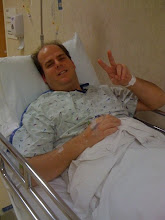
This has been the driving force within me since the moment I woke up from my first brain surgery. I had a painful spinal tap, gauze stuffed up my nose, a hole in my skull, oxygen tubes in my mouth, machines beeping every time I moved (see picture below) … and all I thought was how my first goal was to get to where I was five minutes before this freight train hit me. I’ve done that now. It took me two years. Now the next step is mine.
One week down, one week to go at Cabrillo. The first week of concerts was—in the opinion of many—one of the best in memory. The most exciting part about Cabrillo is the presence of so much artistic excellence everywhere I look. Santa Cruz is small, and the streets have a way of tumbling people into one another. It’s hard to hide and everyone is literally rubbing shoulders with everyone else. As I lean across the breakfast table to grab another bear claw I brush past a Pulitzer Prize-winning composer just idling there, deep in thought as he sips on a cup of coffee. I never mention names in my blog, but the talent out here is on some other astral plane, let me tell you. The orchestra musicians, the soloists, the music direction, the composers and the audiences are all fantastic and we feed off each other’s zeal, passion and energy. Four hundred people attended our first rehearsal. The concerts, featuring some of the most difficult new music imaginable, are sold out. Cabrillo is a special place in my heart, a unique part of music history that rewrites music history every year.
On to my health. Two minor brain shocks last week. I am stressing they were MINOR (only 3 on a scale of 1-10) but they are notable because this is the first recurrence of this phenomenon since May. The image I get (I wrote about this before) is of an alien ray gun pointed at the left side of my head. For a second it feels like my brain melts away and then pops with a painful jolt. A half-note downward glissando with a percussion hit at the end. Before I know what has hit me it is over. I never know when the next one will come. It could be minutes or months. When the two brain shocks hit last week I was deep into playing technical passagework, losing myself in the music.
I try to be careful about this but it’s harder when the musicianship around me is full of fire. In the back of my sinus cavity there is only tissue now where there used to be skull. The hole is about the size of a dime. I have a slice mark on my belly to remind me where they extracted this tissue to plug this hole in my head. Common sense tells me bone is solid and tissue has “give.” With the high air pressure of playing the oboe I wonder if the tissue plug bounces in and out when I play and rest. It’s a little gruesome to think about things like this, but I’m starting to wonder if slight on-off pressure changes in the area of the brain behind my sinuses could be responsible for this intermittent brain shock phenomenon.
When I returned to playing a few months after recovery, I took things easily. I played on the easiest reeds and my orchestra’s management accommodated me with anything I needed for gradually working back to a full schedule, never pressuring me to push it any farther than I wanted to. I was determined every week to be one step farther along while maintaining constant vigilance about watching for leaking spinal fluid again.
Because I took things slowly and carefully, I didn’t suffer setbacks during rehab. I have now tested the tissue plug with the heaviest levels of playing I know and it’s staying put. But I wonder if the plug still moves or bounces a millimeter or two with the pressure changes. Once again, I ask myself how many professional oboists have had two craniopharyngioma resection neurosurgeries and then made it back to their previous level of playing? If I make it through the rest of Cabrillo, I could be the first.


 Posts
Posts